Frequently Asked Questions
The most-asked questions about board wargames.
What is a board wargame?
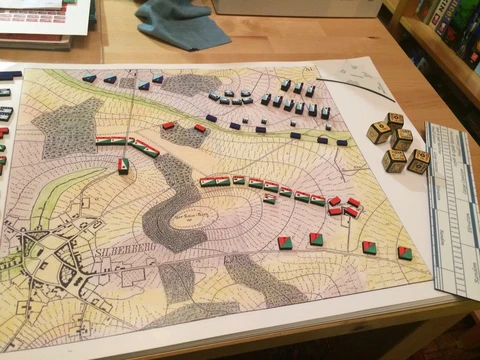
A board wargame is a tabletop simulation of military or strategic conflict in which players command opposing forces using maps, pieces, and structured rules. Core mechanics typically model movement, combat resolution, terrain, supply, and unit capabilities.
How does a wargame differ from a typical board game?
Wargames are built around replicating the logic of warfare—asymmetric unit types, logistics, line-of-sight, and terrain effects—rather than abstract resource collection or point-scoring. They generally demand more reading, longer play times, and a thematic commitment to a specific conflict or setting.
Who are the key figures most associated with the hobby?
Early designers such as Larry Bond, Don LaRue, and Mark Simonitch established many of the design conventions still in use today. On the publishing side, Richard Hudgins founded Avalon Hill in 1952, and later companies like GMT Games and Fantasy Flight Games grew the market into a global hobby.
Where should a newcomer begin?
A common recommendation is to start with a two-player, single-session title that teaches the core move-then-fight loop without overwhelming rule depth. Watching a full playthrough video and, if possible, trying a game at a local game store before purchasing can prevent buyer's remorse.
What does 'hex and counter' mean, and why is it so prevalent?
It describes the standard visual format in which a map is divided into hexagonal spaces and each unit is a small cardboard counter bearing its statistics. The hex grid provides a uniform six-directional adjacency system that simplifies range, movement, and line-of-sight calculations.
What are some of the most well-known titles in the genre?
Advanced Squad Leader, Panzer Legion, and Avalon Hill's World at War are frequently cited as landmark designs. More accessible entries like Twilight Struggle and the Axis & Allies line have introduced millions of players to strategic conflict simulation.
How long does a typical session take?
A focused two-player scenario often runs one to three hours, while complex multi-player or campaign games can stretch to six or eight hours or span several evenings. Designers usually note the expected play time on the box, but it varies with player experience and the rule depth chosen.
Which publishers are most prominent in the wargame space?
GMT Games, Avalon Hill (a Hasbro imprint), and Fantasy Flight Games have long been the biggest names, while numerous smaller and indie studios cover niche eras and mechanics. The rise of Kickstarter and digital adaptations has added a wave of new entrants in recent years.
Where do wargamers meet and discuss the hobby?
Online, the BoardGameGeek wargame forum, dedicated subreddits, and designer-run Discord servers host most of the day-to-day conversation. In person, players gather at local game stores, regional gaming festivals, and larger conventions dedicated specifically to strategic and tactical wargaming.
Do wargames have to be based on real history?
No—the genre's roots are historical, but modern designs span science-fiction, fantasy, and purely abstract strategic settings. The defining trait is the modeling of military decision-making under constraints, not a particular time period or real-world conflict.