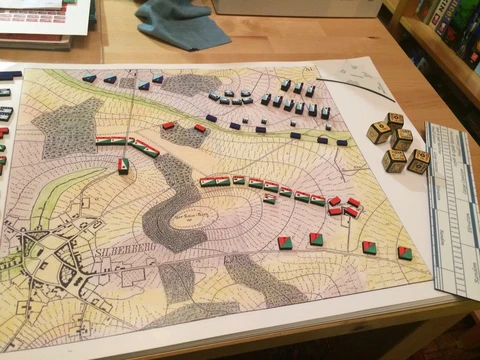
Blitzkrieg (board game)
First commercial wargame simulating a fictional blitzkrieg conflict.

Wikipedia / Wikimedia Commons
Blitzkrieg is a two-player strategic wargame released by Avalon Hill in 1965. It depicts a fictional invasion between two major powers using blitzkrieg tactics, rather than recreating a specific historical battle—a first for commercial wargaming. With nearly 400 playing pieces, it foreshadowed the "monster" wargames of the 1970s, which often featured over a thousand counters.
The game uses a large hex-grid map of a made-up continent, where the two main forces—"Big Red" and "Great Blue"—are separated by neutral countries. Players take turns adding reinforcements, moving units, and resolving combat. Terrain affects movement: clear ground costs one movement point, armor cannot enter forests, and mountains force units to stop and double the defender's combat value. Every unit exerts a zone of control over adjacent hexes, forcing enemy units to halt and fight. Combat is resolved by comparing attacker-to-defender ratios, rolling a die, and consulting an attrition table, which can produce results from a draw to partial or complete elimination. Up to twelve combat value points can be stacked in a single hex, moving at the speed of the slowest piece.
Victory in the basic game (15 turns) requires eliminating all enemy units, occupying all enemy cities for a full turn, or holding more than 25 cities by turn 15. If none of these conditions are met, the game is a draw. The tournament version removes the turn limit, so only the first two victory conditions apply, and draws require mutual agreement.
Blitzkrieg introduced several innovations, including being the first commercial wargame to allow partial eliminations as a combat result. Game historian Harry Lowood noted that players intrigued by its broad military options began experimenting with optional rules, leading to articles in *The General* magazine. He also observed that Jim Dunnigan and Redmond A. Simonsen of rival company Simulations Publications Inc. (SPI) used Blitzkrieg as a foundation for their Blitzkrieg Module System, which eventually produced eighteen modules. These modules let players mix and match new rules—such as navies, neutral armies, railways, production, weather, and guerillas—while still requiring the original Avalon Hill game.
The game was designed by Larry Pinsky and Thomas Shaw, and became a bestseller for Avalon Hill. A second edition, released in 1975 with revised rules and an updated attr
- Publisher
- Avalon Hill
- Year published
- 1965
- Designers
- Larry Pinsky and Thomas Shaw
- Genre
- Strategic-level wargame
- Number of players
- 2
- Notable innovation
- First commercial wargame with partial eliminations as a combat result; first not simulating a historical battle
Lore & Background
Blitzkrieg is a two-player wargame simulating military technology used at the end of World War II. The game uses a large hex grid map of a fictional continent dominated by the major powers "Big Red" and "Great Blue", with several neutral countries separating them. Each turn, Great Blue goes first, adding units from the Order of Appearance sheet, moving, and engaging in combat, followed by Big Red. Terrain affects movement: plain costs 1, armor cannot enter forest, and mountain hexes require a full turn to traverse while doubling defenders' value. Units exert a zone of control in adjacent hexes, forcing enemy units to stop and engage. Combat is resolved by comparing attacker-to-defender ratios and rolling a die on the Attrition Table, with results ranging from draw to forced retreat or elimination. Players can stack units up to a combined combat value of 12, moving at the slowest counter's rate.
Reader's Guide
Blitzkrieg was innovative in several respects, including being the first commercial wargame to offer partial eliminations as a combat result, and also the first that did not simulate a specific historical battle. Game historian Harry Lowood noted that "Players intrigued by the unprecedented array of military options in the game noticed the potential for experimentation, and a few articles proposing optional rules and other variants appeared in The General along with dozens of strategy articles." Lowood also noted that Jim Dunnigan and Redmond A. Simonsen of rival game company Simulations Publications Inc. used Blitzkrieg as a "starting point" for their new Blitzkrieg Module System series, which ultimately produced eighteen modules. Ten years after its original publication, Dave Roberts revised the rules and Avalon Hill published a second edition in 1975 that used all of the original components except for a revised rulebook and Attrition Table. By that time, the innovations of the original edition had inspired a new generation of monster wargames, and Blitzkrieg, even with revised rules, was seen as outmoded. The game was a bestseller for the company and paved the way for "monster" wargames of more than 1,000 counters.
Did You Know?
- Blitzkrieg was the first commercial wargame that did not simulate an actual historical battle.
- It was the first commercial wargame to offer partial eliminations as a combat result.
- SPI's Blitzkrieg Module System produced eighteen modules, but players still needed a copy of Avalon Hill's original Blitzkrieg to use them.
- A copy of Blitzkrieg is held in the collection of the Strong National Museum of Play (object 112.6283).
Frequently Asked Questions
What is Blitzkrieg (1965) and who designed it?
Blitzkrieg is a two-player strategic wargame published by Avalon Hill in 1965, created by designers Larry Pinsky and Thomas Shaw. It pits two fictional superpowers, 'Big Red' and 'Great Blue,' against each other across a made-up continental map.
How is Blitzkrieg different from other early wargames?
Rather than recreating a specific historical battle, Blitzkrieg simulates a fictional blitzkrieg-style invasion, making it a first for commercial wargaming. It also introduced partial unit losses as a combat result, so a losing stack could survive with reduced strength instead of being wiped out entirely.
What does a typical turn look like in Blitzkrieg?
On each turn a player reinforces their army, maneuvers units across the large hex-grid map, and resolves combat where opposing forces meet. The two main powers start separated by neutral territories that must be crossed or flanked to reach the enemy.
How many counters come in the Blitzkrieg box?
The game includes nearly 400 individual playing pieces, which was a remarkably large component count for its time. That scale helped pave the way for the 'monster' wargames of the 1970s that routinely featured over a thousand counters.
Why is Blitzkrieg still considered a landmark in wargame history?
It demonstrated that a commercially successful wargame did not have to be tied to a real historical event, opening the door for fictional strategic conflicts. Its partial-elimination combat mechanic also became a design template that later wargame creators frequently borrowed and expanded upon.
More in Board wargames 1-24
Spotted an error? Know more?
This is a living reference — every entry is fact-audited, and reader corrections feed straight into our audit queue. Suggest an edit · See this site's audit record