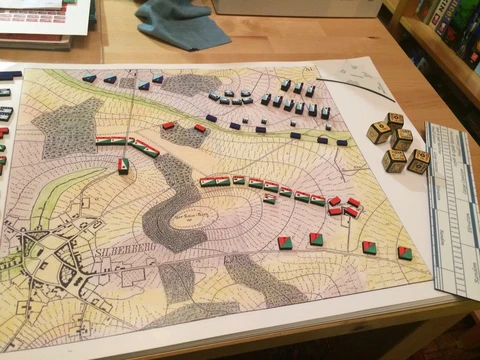
Block wargame
Wooden blocks hide unit strength, simulating fog of war.

Wikipedia / Wikimedia Commons
A block wargame is a board wargame that represents military units using wooden blocks instead of cardboard counters or metal/plastic miniatures. The blocks are typically square, have a labeled and an unlabeled side, and are thick enough to be placed on their side with the labeled side facing the owning player, preserving the secrecy of unit type and quality to emulate fog of war. The concept traces back to the 1908 introduction of L'Attaque, the first version of Stratego, though Stratego was not a direct inspiration for block wargames.
- first_block_wargame
- Quebec 1759 (1972)
- initial_publisher
- Gamma Two Games (later Columbia Games)
- key_innovator
- Lance Gutteridge
- core_mechanic
- Step-reduction system using numbered pips on blocks
- modern_publishers
- Columbia Games, GMT Games, Simmons Games, VentoNuovo Games
Lore & Background
In 1972, Lance Gutteridge of Gamma Two Games originally planned to use six-sided dice to represent pieces and provide step reduction in combat strength, but the high cost of dice led him to instead use embossed wooden blocks showing 2, 3, or 4 steps. The first such block wargame was Quebec 1759, depicting the campaign surrounding the Battle of the Plains of Abraham. Gamma Two later produced War of 1812 and Napoleon, and in 1982 changed its name to Columbia Games.
Reader's Guide
Through the 1980s and 1990s, Columbia Games was practically the sole publisher of block wargames, releasing titles such as Rommel in the Desert, EastFront and its sequels, and Bobby Lee and Sam Grant. The only significant change was replacing embossed wooden blocks with plain plastic blocks and stickers. Block wargames are enjoying a minor resurgence, with Columbia Games' Hammer of the Scots and Crusader Rex by Jerry Taylor being well received. GMT Games entered the market in 2003 with Europe Engulfed, and later released Asia Engulfed and the Commands and Colors: Ancients series, though the latter does not fall under the traditional definition as units have identifying marks on both sides. Simmons Games published Bonaparte at Marengo, featuring unique long blocks. Since 2011, VentoNuovo Games has modernized the sector with new logical algorithms and ultra-detailed topographic maps, becoming the most active company with 14 published titles.
Did You Know?
- The first block wargame was Quebec 1759, published in 1972 by Gamma Two Games.
- Lance Gutteridge originally planned to use six-sided dice but switched to wooden blocks due to the high cost of dice.
- Columbia Games replaced embossed wooden blocks with plain plastic blocks and stickers.
- The Commands and Colors: Ancients series does not fall under the traditional definition of block wargame because units have identifying marks on both sides.
Frequently Asked Questions
What is a block wargame?
A block wargame is a board wargame that uses small wooden blocks as its unit tokens rather than traditional cardboard counters or painted miniatures. Each block is typically square and features a printed face on one side while the opposite side remains blank.
What is the first block wargame ever published?
Quebec 1759, released in 1972 by Gamma Two Games (which later became Columbia Games), is recognized as the earliest block wargame. It established the foundational format that subsequent titles in the genre have followed.
How do block wargames handle hidden information?
Because the blocks are thick enough to be stood on their edge, each player faces their own labeled side while opponents see only the blank face. This physical setup conceals unit type and strength, recreating the uncertainty of real combat often called fog of war.
Who is credited with developing the block wargame format?
Lance Gutteridge is widely regarded as the key innovator behind the block wargame concept. His step-reduction system, which uses numbered pips printed on the blocks to track unit degradation, became the defining mechanical framework for the genre.
Which publishers currently produce block wargames?
Columbia Games, GMT Games, Simmons Games, and VentoNuovo Games are all active publishers in the block wargame space. The lineage stretches back to Gamma Two Games, the original 1972 publisher that was eventually absorbed into Columbia Games.
More in Board wargames 1-24
Spotted an error? Know more?
This is a living reference — every entry is fact-audited, and reader corrections feed straight into our audit queue. Suggest an edit · See this site's audit record