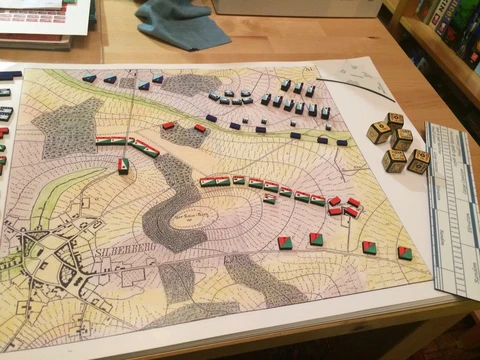
Board wargame
A hobby simulating conflict on a board, born in 1954.

Wikipedia / Wikimedia Commons
A board wargame is a wargame played on a set playing surface or board, distinct from computer or miniatures wargames. The modern commercial hobby began in 1954 with the publication of Tactics, and it continues to have a sizeable following with dedicated publishers and conventions worldwide.
- field
- Board wargaming
- known_for
- Simulating historical battles and conflicts on a board
- first_modern_game
- Tactics (1954)
- key_publisher
- The Avalon Hill Game Company
- golden_age
- 1975–1980
Lore & Background
The first modern mass-market board wargame was Tactics, designed by Charles S. Roberts in 1953 and published in 1954 by The Avalon Game Company. It sold about 2,000 copies, convincing Roberts of a market for adult strategy games. In 1958, Avalon Hill published Tactics II and Gettysburg, the first board game to simulate a historical battle. Avalon Hill dominated the early history, though financial troubles led to its sale in 1963 to Monarch Avalon Printing, which improved component quality. The company's conservative output—about two titles per year, half of which were wargames—spawned devoted followings for games like D-Day and Stalingrad, despite their unhistorical and unbalanced nature.
Reader's Guide
Board wargames range from simple 'beer-and-pretzel' games to complex 'consim' (conflict simulation) games that prioritize historical realism. This creates a long-running debate about 'realism vs. playability'. Games are typically representational, using soldier-shaped pieces on a map-like board, often called 'dudes on a map' games. They usually depict concrete historical subjects like the Battle of Gettysburg, but also extend to non-historical topics such as hypothetical Cold War conflicts. Fantasy and science-fiction subjects are sometimes excluded from the wargame label because they lack real-world models, but they use the same game mechanics. More serious wargames tend toward complex rules, more calculation, exceptions for unique historical circumstances, and greater detail or 'chrome'. The extreme end includes 'monster games' like Terrible Swift Sword, which tracks individual regiments at Gettysburg and uses multiple map sheets and thousands of counters. Player knowledge and action are typically less limited than in real life; some games include command and control or fog of war rules, which can be cumbersome, though block wargames offer a more playable solution.
Did You Know?
- The first modern mass-market board wargame, Tactics, was designed by Charles S. Roberts in 1953 and published in 1954.
- Avalon Hill's Gettysburg (1958) was the first board game designed to simulate a historical battle.
- The magazine Strategy & Tactics, acquired by Jim Dunnigan, included a new game in every issue, helping SPI surpass Avalon Hill in number of titles.
- The period 1975–1980 is considered the 'Golden Age of Wargaming', with a large number of new companies and diversification into science-fiction wargames.
Frequently Asked Questions
What exactly is a board wargame?
A board wargame is a tabletop conflict simulation played on a fixed playing surface, setting it apart from computer-driven or free-movement miniature wargames. Players represent opposing forces and resolve engagements using rules printed on or alongside the board.
When did the modern board wargame hobby start?
The commercial hobby is generally traced to 1954, when the game Tactics was published and established the template for two-player historical conflict simulation on a grid. That title launched a wave of dedicated publishers and a lasting player community.
Which publisher is most associated with the hobby's early growth?
The Avalon Hill Game Company is widely regarded as the foundational commercial publisher, producing a large catalog of historical and strategic board wargames that defined the genre for decades.
What period is considered the golden age of board wargaming?
Fans typically point to the mid-1970s through 1980 as the peak era, when the hobby saw its greatest concentration of new titles, active conventions, and dedicated subscriber bases.
Why do people still play board wargames today?
The core appeal remains the tactile, rules-driven simulation of historical battles and broader conflicts without needing screens or expensive miniature armies. A dedicated global community of publishers, convention organizers, and players keeps the hobby vibrant well beyond its 1954 origins.
More in Board wargames 1-24
Spotted an error? Know more?
This is a living reference — every entry is fact-audited, and reader corrections feed straight into our audit queue. Suggest an edit · See this site's audit record