Dixie (board wargame)
Alternate-history wargame that debuted the Administration Points system.
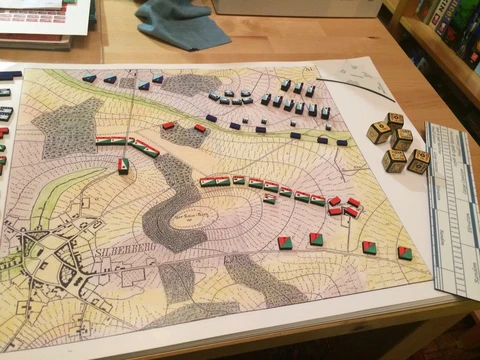
Dixie, subtitled "The Second War Between the States", is a board wargame from 1976. Designed by Redmond A. Simonsen and released by Simulations Publications, Inc. (SPI), it presents an alternate history where the Union lost the first American Civil War, leading to a second conflict between the North and the South in the early 1900s. It is a two-player game that operates at the brigade and division level.
The game introduced Administration Points, a system that controls how much a player can do each turn. Players receive a set number of these points and spend them to purchase actions—for instance, bringing a replacement infantry division onto the board costs two points. The game includes three scenarios set in 1936 and 1937. Its components consist of a 22" x 17" paper map, four player aid sheets, a rulebook, 100 die-cut counters, and randomizer chits that replace dice.
Dixie first appeared as a pull-out game in issue #116 of *Strategy & Tactics* magazine in 1976. SPI also released it as a standalone product in a cardstock folio.
Reception was mixed. In *JagdPanther* #13, Steve Daniels noted that the Administration Points system had both supporters and detractors, with some players discarding it entirely to speed up the game, though this made outcomes "brief and bloody." He suggested a variant with more units, European intervention, and tactical air support. In *Perfidious Albion* #5, Charles Vasey found the system too abstract to feel realistic, while Geoff Barnard thought the point-expenditure mechanic was interesting and worked well, though he felt the game itself was "far too artificial" to hold much interest beyond testing the resource system. Eric Goldberg, writing in *Ares Magazine* #1, gave Dixie a rating of 2 out of 9, calling it "How Not to Design a Wargame." He criticized the equal starting forces and argued that mastery of the Administration Points system decided the game regardless of other play. He concluded that only students of wargame history might care to note the invention of Administrative Points. Nick Palmer, in his 1977 book *The Comprehensive Guide to Board Wargaming*, remarked that the premise had "zany appeal" but noted that a majority of SPI poll respondents rated the game negatively. *Board Game Wizard* included Dixie in its list of "Best Board Games of the 70's," describing it as a weird alternate history that some players enjoye
- designer
- Redmond A. Simonsen
- publisher
- Simulations Publications, Inc. (SPI)
- year_published
- 1976
- genre
- alternate history board wargame
- scale
- brigade/division level
- players
- 2
- notable_mechanic
- first wargame to use Administration Points
Lore & Background
Dixie was first published as a pull-out game in issue #116 of Strategy & Tactics in 1976, and later as a stand-alone product in a cardstock folio. The game includes a 22" x 17" paper map, four player aid sheets, a rulebook, 100 die-cut counters, and randomizer chits instead of dice. It offers three scenarios set in 1936 and 1937.
Reader's Guide
Dixie's primary significance lies in its introduction of Administration Points, a mechanic that regulates how many actions a player can take per turn by requiring them to 'buy' actions such as bringing replacement units onto the board. This system was controversial among reviewers: some found it too abstract and artificial, while others appreciated its novelty and resource-management challenge. The game itself received mixed to negative reviews, with critics noting that both sides start with equal forces and that mastery of the Administration Points system often determined the winner regardless of strategic play. Despite its lukewarm reception, the Administration Points concept became an experimental foundation for later wargames, and Dixie is remembered primarily as a design milestone rather than a popular game. It was included in Board Game Wizard's list of 'Best Board Games of the 70's', though the same source noted it 'didn’t engage that well overall.'
Did You Know?
- Dixie was the first wargame to use Administration Points as a way of regulating how much can be accomplished in a turn.
- The game includes randomizer chits to replace dice.
- In a poll conducted by SPI, over two-thirds of wargamers knew the game, but most gave it a negative rating.
- Eric Goldberg, writing in Ares Magazine #1, gave Dixie a rating of only 2 out of 9.
Frequently Asked Questions
Who is Dixie (board wargame)?
Dixie is a two-player alternate-history board wargame published in 1976 by Simulations Publications, Inc. (SPI), designed by Redmond A. Simonsen. It simulates a hypothetical second war between the United States and the Confederate States in the early 1900s.
What is the premise of Dixie (board wargame)?
The game imagines a timeline in which the Union lost the original Civil War, leaving the South as a surviving independent nation. That unresolved rivalry eventually erupts into a full-scale second conflict between North and South around the turn of the twentieth century.
How does the Administration Points system work in Dixie (board wargame)?
Each turn a player receives a fixed pool of Administration Points and must spend them to authorize military or political actions. This mechanic caps how much a player can accomplish in a single round, adding a layer of strategic resource management on top of the tactical map play.
What scale does Dixie (board wargame) operate at?
The game models combat at the brigade and division level rather than at individual unit or corps level. This gives players enough granularity for meaningful tactical decisions while keeping the scope manageable for a two-player session.
Why is Dixie (board wargame) important in wargame history?
Dixie is widely credited as the debut of the Administration Points mechanic, which went on to influence numerous later SPI titles and the broader wargaming genre. Its speculative alternate-history framing also helped establish non-standard scenarios as a legitimate design space for board wargames.
More in Board wargames 1-24
Spotted an error? Know more?
This is a living reference — every entry is fact-audited, and reader corrections feed straight into our audit queue. Suggest an edit · See this site's audit record