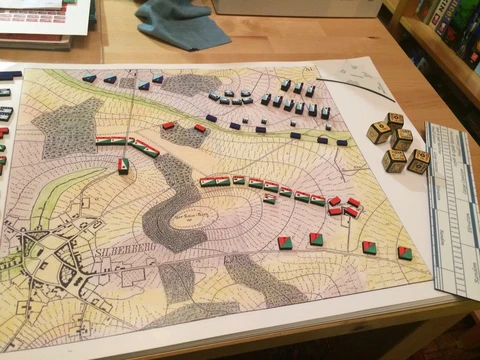
Ring of Fire (wargame)
A two-player wargame simulating the Fourth Battle of Kharkov.
**Ring of Fire (wargame)**
*Ring of Fire*, subtitled *The Fourth Battle for Kharkov, August 1943*, is a two-player board wargame published by Moments in History (MiH) in 1994. It simulates the Fourth Battle of Kharkov during World War II at the operational level, with one player commanding German forces and the other Soviet forces.
**Background** By mid-1943, the German invasion of the Soviet Union, launched with Operation Barbarossa in June 1941, had stalled, forcing German forces onto the defensive. The city of Kharkov changed hands repeatedly in the ensuing back-and-forth fighting. In July 1943, it was again under German control, with Army Group South entrenched east of the city. On 3 August 1943, the Soviet Voronezh and Steppe Fronts launched Operation General Rumyantsev, aiming to break through German lines, retake Kharkov, encircle and destroy Army Group South, and open a path toward Germany.
**Components** The game box contains a 22" x 34" hex grid map (scaled at 2 km per hex), 360 double-sided counters, a 24-page rulebook, and various player aids. It also includes a 60-minute audiocassette offering instructions and suggestions.
**Setup** Unlike many wargames that prescribe fixed starting positions, *Ring of Fire* allows both players to freely place their initial forces on the map in any formation they choose.
**Gameplay** Each player’s turn follows a sequence: regular movement, combat, Reserve movement, and a second combat phase for units that moved no more than half their regular movement allowance. Tanks stacked together do not combine their fire into a single die roll, nor do attacks on a tank stack damage the entire stack. Instead, each tank fires individually at one target. Firing order and number of shots depend on tank quality—a high-quality tank (rating 4) fires first and more often than a low-quality one (rating 1). As critic Charles Vasey noted, this system results in heavy losses when tanks engage.
**Scenarios** Two scenarios are included: a short introductory scenario covering the first four turns of the Soviet attack, and the full battle, which takes an estimated 5–8 hours to play.
**Strategy** Designer John Desch emphasized that once armies are engaged, a commander’s main influence is the release of reserves. Critic Scott Johnson observed that shrewd use of reserves can secure key terrain offensively or halt an enemy
- publisher
- Moments in History (MiH)
- year_published
- 1994
- designer
- John Densch
- subject
- Fourth Battle of Kharkov, August 1943
- players
- 2
- scale
- 2 km per hex
Lore & Background
The game covers the period after the German offensive Operation Barbarossa had stalled, and the city of Kharkov had changed hands several times. By July 1943, Kharkov was in German hands, and on 3 August 1943, the Soviet Voronezh and Steppe Fronts launched Operation General Rumyantsev to retake the city and potentially break through to Germany. Ring of Fire includes a 22" x 34" hex grid map, 360 two-sided counters, a 24-page rulebook, player aids, and a 60-minute audiocassette with instructions and suggestions. Unlike many wargames, both players are free to place their initial forces in any formation they wish.
Reader's Guide
Ring of Fire is notable for its unique tank combat system, where tanks fire individually rather than combining shots, and firing order is determined by tank quality. The game also features a two-phase combat system and emphasizes the use of reserves, which designer John Densch called one of the few influences a commander can exert once armies are engaged. The game includes two scenarios: a short introductory scenario and the full battle, estimated to take 5–8 hours. It was a finalist for the 1994 Charles S. Roberts Award for Best World War II Board Game, and received positive reviews for its concise rules, clear presentation, and engaging gameplay.
Did You Know?
- Ring of Fire includes a 60-minute audiocassette with instructions and suggestions.
- Unlike many wargames, players are free to place their initial forces in any formation they wish.
- The game was a finalist in the 'Best World War II Board Game' category at the 1994 Charles S. Roberts Awards.
- A Japanese-language version was published by Kokusai-Tsushin in 1997 in Issue 14 of Command.
More in Board wargames 1-24
Spotted an error? Know more?
This is a living reference — every entry is fact-audited, and reader corrections feed straight into our audit queue. Suggest an edit · See this site's audit record