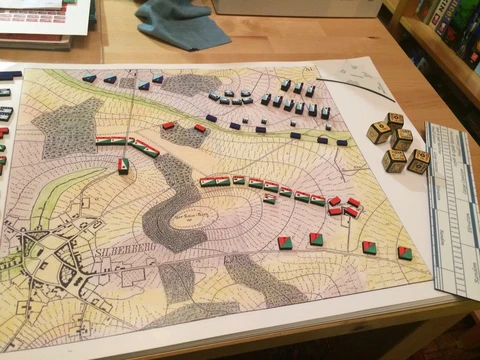
Solitaire board wargame
Solitaire wargames simulate opponents for single-player historical decision-making.
Solitaire board wargames are a subgenre of board wargaming designed for a single player, with the game system simulating an opponent. They have existed commercially since at least the early 1970s, with early examples including Operation Olympic (1974) and Iwo Jima (1983). These games aim to immerse the player in historical decision-making, though they are often seen as puzzles where enjoyment comes from both playing and solving.
- field
- Board wargaming
- known_for
- Solitaire play systems, simulated opponents, paragraph-driven gameplay
- earliest_known_title
- Operation Olympic (1974)
- notable_early_titles
- Iwo Jima (1983), B-17 Queen of the Skies (1983), Ambush! (1984)
Lore & Background
The first commercial solitaire board wargames appeared in the 1970s and 1980s. Operation Olympic, published in 1974, is considered perhaps the earliest. Iwo Jima, a magazine game by TSR released in 1983, was one of the first solitaire board wargames. That same year, Avalon Hill produced B-17, Queen of the Skies, possibly the first boxed solitaire board wargame. Ambush!, released in 1984, is arguably the most successful solitaire board wargame ever made, spawning three add-on games, a companion series, a two-player version, and a similar game focusing on armor in World War II. Another 1984 title, Ranger by Omega Games, focused on patrolling missions in a fictional Central American conflict. Ambush! validated the concept of designing specifically for solitaire play, leading to titles such as Mosby's Raiders (1985), Eastern Front Solitaire (1986), Raid on St. Nazaire (1987), Tokyo Express (1988), Open Fire (1988), and Solitaire Advanced Squad Leader (1995). More recently, downloadable titles like Solitaire Caesar, Barbarossa Solitaire, and Vietnam Solitaire have appeared on wargamedownloads.com.
Reader's Guide
The key design concept in solitaire wargames is creating a simulated opponent. Early games used static defenses (Iwo Jima) or charts and dice rolls (B-17). Ambush! innovated with mission cards read in a view sleeve, revealing three-digit numbers that corresponded to numbered paragraphs in a book, orienting the player, activating the opponent, or providing atmosphere. Ranger was also paragraph-driven but lacked counters and was more abstract. Combat! uses a card-based initiative track to determine enemy unit order. B-17 is considered an unsuccessful design because it presents no realistic challenges akin to those faced by a historical B-17 pilot; the player is largely a spectator to random events. Tokyo Express, by contrast, is praised for its well-designed solitaire system that makes the player experience the suspense and confusion of command without hidden paragraphs. A disadvantage of solitaire games is that the player has few checks on rule understanding, leading to potential misinterpretations. There is also a trade-off between immersion and replayability: Ambush! has high detail but low replayability due to surprise, while Tokyo Express and B-17 are infinitely replayable but less immersive. Despite a decline in solitaire board wargame releases after the 1980s, there has been a resurgence in the past ten years, with new titles such as Hornet Leader, RAF, Field Commander Rommel, Silent War, and others, as well as cooperative games like Pandemic and Arkham Horror that play well solo.
Did You Know?
- Operation Olympic, published in 1974, is perhaps the earliest commercial solitaire board wargame.
- Ambush! (1984) is arguably the most successful solitaire board wargame ever made.
- B-17, Queen of the Skies is considered an unsuccessful design because it presents no realistic challenges akin to those faced by a historical B-17 pilot.
- Tokyo Express uses no hidden paragraphs and is designed to be replayable again and again.
More in Board wargames 1-24
Spotted an error? Know more?
This is a living reference — every entry is fact-audited, and reader corrections feed straight into our audit queue. Suggest an edit · See this site's audit record