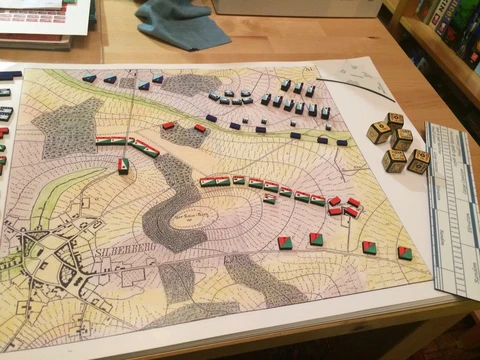
Tactical wargame
Tactical wargames model small-unit military conflict.
Tactical wargames are a type of wargame that models military conflict at a tactical level, with units ranging from individual vehicles and squads to platoons or companies. These games are designed so that knowledge of military tactics facilitates good gameplay, and they offer more of a challenge to the designer because fewer variables are directly quantifiable. The first tactical wargames were played as miniatures, later extended to board games, and are now also played as video games.
- field
- Wargaming
- known_for
- Modeling military conflict at the tactical level, with units rated based on individual weaponry
- first_board_wargame_year
- 1969
- notable_system
- Advanced Squad Leader
Lore & Background
The genesis of tactical board wargaming goes back to 1969. Up until that time, wargaming—which in the modern, recreational form only dated back to 1958—tended to concentrate on operational and strategic subjects. Charles S. Roberts of Avalon Hill had developed a wide range of strategic wargames based upon historical battles, but most were at the army, brigade, battalion, or regiment level. Tactical Game 3 was introduced by Strategy & Tactics magazine as a platoon/company level game focusing on tactics on the Eastern Front. In 1970, that game's designer, James F. Dunnigan, sold the rights to Avalon Hill, who quickly released PanzerBlitz, starting the so-called 'Second Generation' of wargaming. PanzerBlitz eventually sold 250,000 copies, though it was not without critics, including Dunnigan himself.
In the early 1970s, several tactical games appeared, including Grunt (1971) featuring platoon-level warfare in Vietnam, Combat Command (1972) billed as a western front sequel to PanzerBlitz, and Soldiers (1972) about World War I, all by Dunnigan/SPI. Dunnigan then released Red Star/White Star, the first game on the then-ongoing Cold War. He tried a new direction in 1973 with KampfPanzer and Desert War, featuring simultaneous movement, but the quest for greater realism increased complexity and bookkeeping. Other man-to-man games followed, including Sniper! (1973), Patrol! and Tank! (both 1974). That same year, Avalon Hill released Panzer Leader.
Problems with true tactical games were apparent, including the sequential nature of turns and unrealistic situations. SPI replaced earlier titles with a new 'Simultaneous-Sequential-Play-System' (SSPS), which allowed greater realism without sacrificing playability. This system was extended to Avalon Hill's Tobruk in 1976 and SPI's Firefight, but neither did well, with increased realism in the form of detailed penetration tables and rigid rules making games less playable. Tobruk also suffered from an unattractive map surface depicting basically flat terrain.
Reader's Guide
Tactical wargames represent a significant evolution in recreational wargaming, shifting focus from large-scale strategic and operational conflicts to the detailed simulation of small-unit engagements. Their importance lies in the challenge they pose to designers, who must quantify variables inherent in individual weaponry and unit capabilities. The genre's development from miniatures to board games and video games reflects a broader trend toward granularity and realism in gaming. The success of PanzerBlitz, selling 250,000 copies, demonstrated the commercial viability of tactical subjects, while the subsequent introduction of the Simultaneous-Sequential-Play-System addressed criticisms of sequential turn-based play. Despite setbacks with overly complex games like Tobruk and Firefight, the genre remained a favorite among wargamers, with Advanced Squad Leader becoming perhaps the most successful board wargaming system ever designed. The legacy of tactical wargames includes their influence on later video game adaptations and their enduring appeal to players seeking historically grounded, intellectually demanding gameplay.
Did You Know?
- The first tactical board wargame was introduced in 1969 by Strategy & Tactics magazine as Tactical Game 3.
- PanzerBlitz, released in 1970, sold 250,000 copies and was designed by James F. Dunnigan.
- The Simultaneous-Sequential-Play-System (SSPS) was introduced to address problems with sequential turn-based play.
- Advanced Squad Leader is considered perhaps the most successful board wargaming system ever designed.
More in Board wargames 1-24
Spotted an error? Know more?
This is a living reference — every entry is fact-audited, and reader corrections feed straight into our audit queue. Suggest an edit · See this site's audit record