Tactics (game)
First commercially successful board wargame, published 1954.
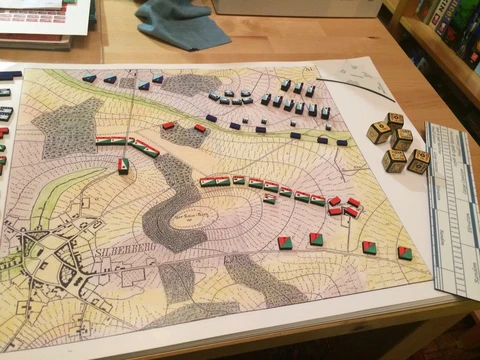
Tactics, released in 1954, was the first product from Avalon Hill and is widely considered the first commercially successful board wargame. Along with its follow-up, Tactics II, it marked the beginning of modern board wargaming for the commercial market, even though it looks primitive today.
Before the 1950s, wargames typically came as rule sets only, requiring players to supply their own miniature soldiers and build terrain. Charles S. Roberts believed a complete, self-contained game—with a map, cardboard counters, rules, and a box—could find a market. Starting in 1952, he worked on such a design from his home in the Avalon neighborhood of Catonsville, Maryland. His game resembled earlier English wargames but was enough of an improvement to be considered the first second-generation print wargame for civilians. Roberts recalled that its revolutionary design confused players used to chess and checkers.
Roberts self-published *Tactics* in 1954 under the name "The Avalon Game Company," later changed to Avalon Hill. For six years, he sold it by mail order from his home near Baltimore, moving 2,000 copies and barely breaking even. In 1958, he replaced it with *Tactics II*, which had nearly identical rules but slightly altered maps and counters. Avalon Hill released an updated edition in 1961, then discontinued production in 1972 due to rising costs. In 1973, *Tactics II* was redesigned with cheaper components and sold as a loss-leader to attract new players. A 25th anniversary edition of the original *Tactics*, with a new map, came out in 1983.
The game is for two players, who command the armies of two imaginary nations, Blue and Red. Both sides have identical forces, but their geography differs. Gameplay introduced several now-standard mechanics: an odds-ratio combat results table (CRT), different movement costs for different terrain types on a square grid, and alternating "I Go, You Go" turns where one player moves and attacks before the other does. Cardboard counters had appeared earlier in a 1911 game, but *Tactics* popularized their use. Counters include armored units, headquarters, infantry, mountaineers, paratroopers, and amphibious units. Special rules cover roads, hidden movement, and these specialized troops, with optional rules for nuclear weapons, reinforcements, supply, and weather.
Reception was mixed. In 1976, *Games & Puzzles* noted the game w
- publisher
- Avalon Hill (originally The Avalon Game Company)
- year_published
- 1954
- designer
- Charles S. Roberts
- genre
- Board wargame
- players
- 2
- notable_for
- First commercially successful board wargame
Lore & Background
Charles S. Roberts began work on designing Tactics in 1952 from his house in the Avalon neighborhood of Catonsville, Maryland. He believed there was a market for an entirely self-contained wargame that would include a map and soldiers in the form of cardboard counters, as well as rules and a box. Roberts self-published the game in 1954 using the name 'The Avalon Game Company', later changed to Avalon Hill. For the first six years, he sold the game on a mail order basis from his home, selling 2,000 copies and barely breaking even.
Tactics was a revolutionary design that confounded new players more accustomed to rules like chess and checkers. It introduced a totally new method of play: players could move up to all of their pieces on a turn, movement up to certain limits was at the player’s option, and combat resolution was at the throw of a die compared to a table of varying results. The game pioneered mechanics such as the odds-ratio combat results table (CRT), different movement costs for terrain, and the use of cardboard counters.
In 1958, Roberts replaced Tactics with a revised game titled Tactics II, with nearly identical rules and slight changes to the map and counters. An updated edition of Tactics II was produced in 1961. Production was discontinued in 1972 due to rising costs, but in 1973 the game was redesigned with less costly components and sold as a loss-leader. In 1983, Avalon Hill released a 25th anniversary edition of the original Tactics with a new and different map.
Reader's Guide
Tactics holds a foundational place in the history of board wargaming as the first commercially successful product of its kind. Before its release, wargames were usually just sets of rules requiring players to provide their own miniatures and terrain. Tactics introduced the concept of a self-contained game with a map, cardboard counters, rules, and a box, setting the template for the modern board wargame industry. Its design innovations—such as the odds-ratio combat results table, variable movement costs for terrain, and the 'I Go, You Go' turn structure—became standard features in countless later wargames.
Despite its significance, the game was not without criticism. In 1976, the UK magazine Games & Puzzles noted that its main shortcoming was the use of a square grid rather than a hex grid, which later became the industry standard. Martin Campion, writing in 1980, observed that many old-timers had a soft spot for it and that it served as an introductory game for many wargamers, though he noted its representation of World War II conditions was oversimplified. Nonetheless, Tactics and its sequel Tactics II are credited with launching the commercial board wargaming hobby and establishing Avalon Hill as a major publisher in the field.
Did You Know?
- Tactics was designed by Charles S. Roberts from his house in the Avalon neighborhood of Catonsville, Maryland.
- The game was originally self-published under the name 'The Avalon Game Company', later changed to Avalon Hill.
- Tactics introduced the odds-ratio combat results table (CRT), a mechanic that became standard in board wargaming.
- A 25th anniversary edition of the original Tactics was released in 1983 with a new and different map.
More in Board wargames 1-24
Spotted an error? Know more?
This is a living reference — every entry is fact-audited, and reader corrections feed straight into our audit queue. Suggest an edit · See this site's audit record